Questions & answers
What CalCollapse does with your calendars, and what setting it up looks like.
Setting it up
Nine screens if you connect Google, fewer if you paste a webcal instead. The one that takes longest is the second, and only because it happens on Apple’s site rather than ours. Google is optional: after iCloud you can skip those two screens and paste a subscription URL.
Sign in with Apple
This only identifies you. It gives us no access to your calendars at all — that comes later, and separately.
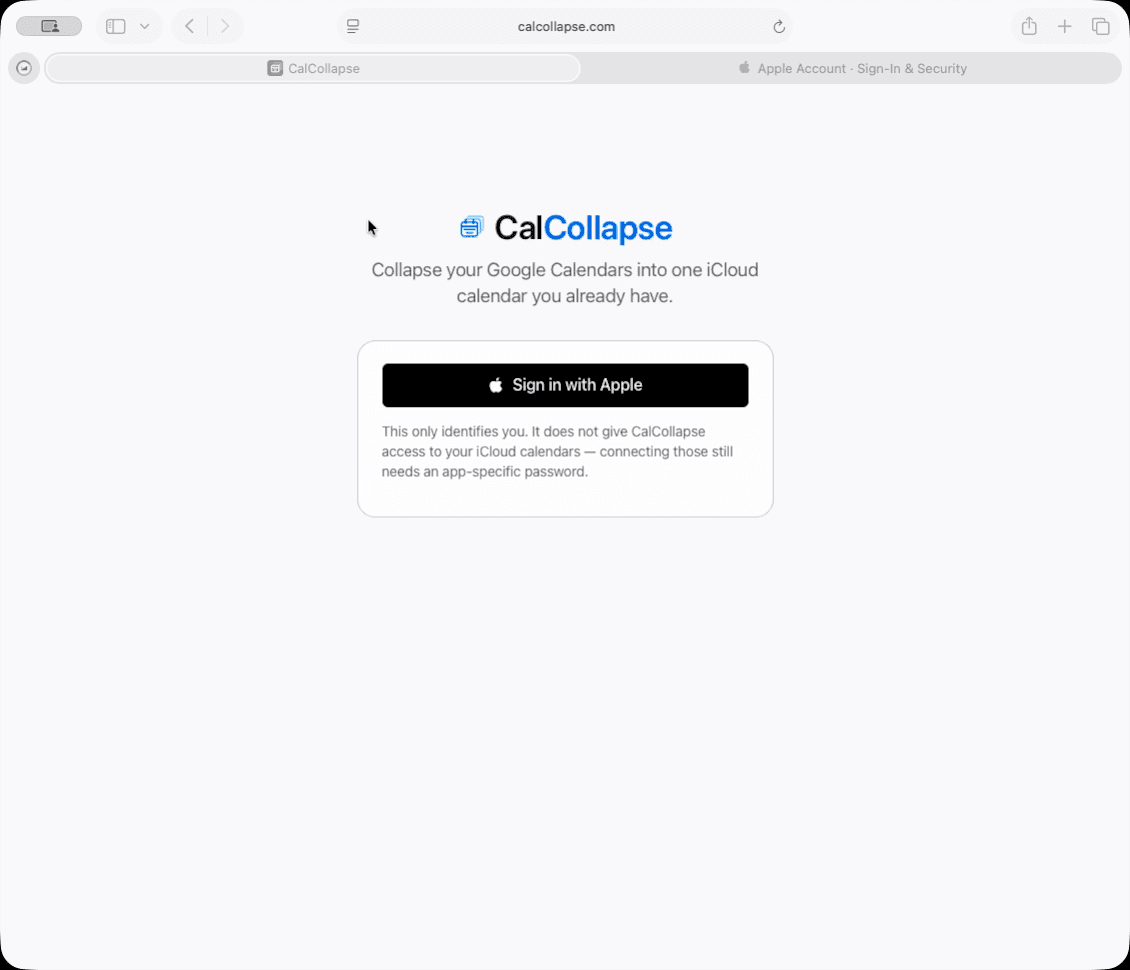
Open Sign-In & Security at account.apple.com
In a second tab, sign in to your Apple Account and find App-Specific Passwords at the bottom of the Sign-In & Security page.
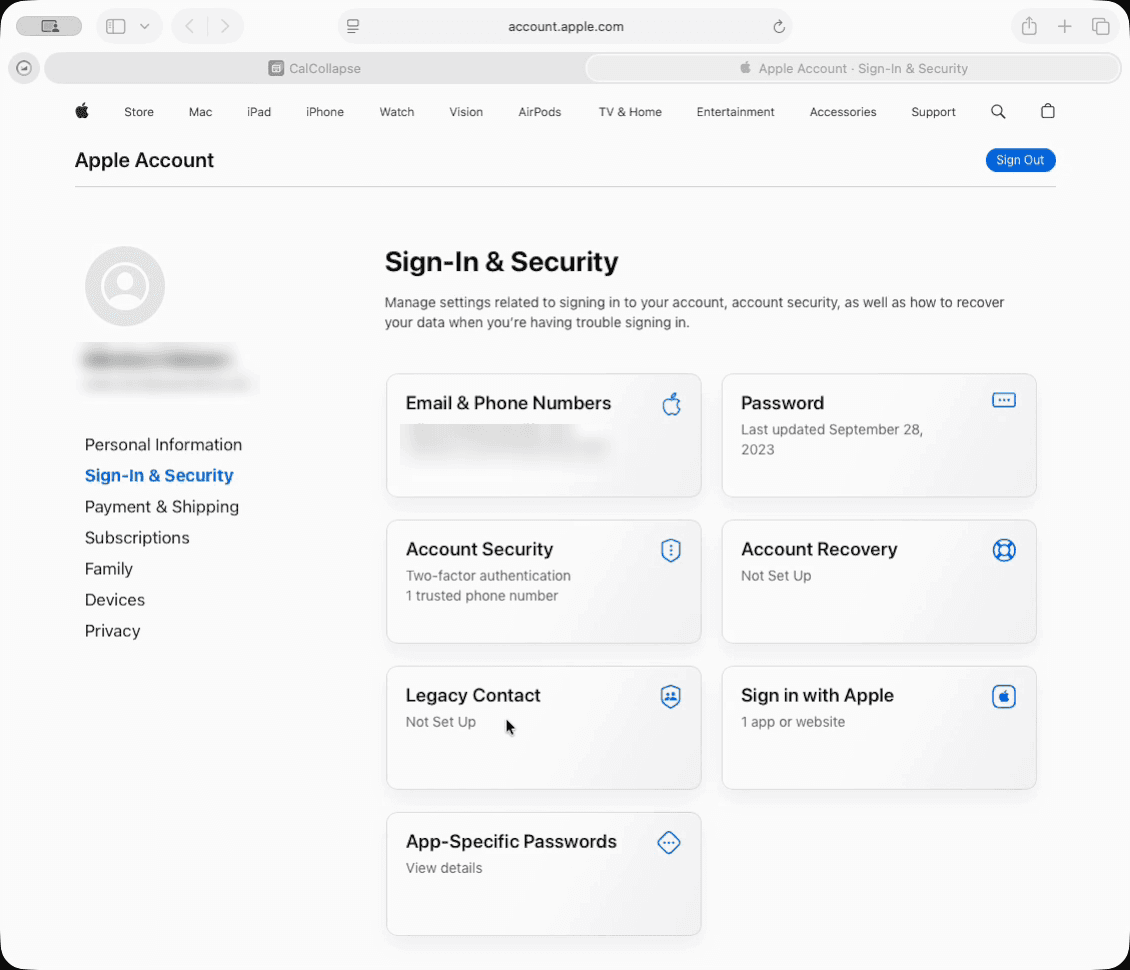
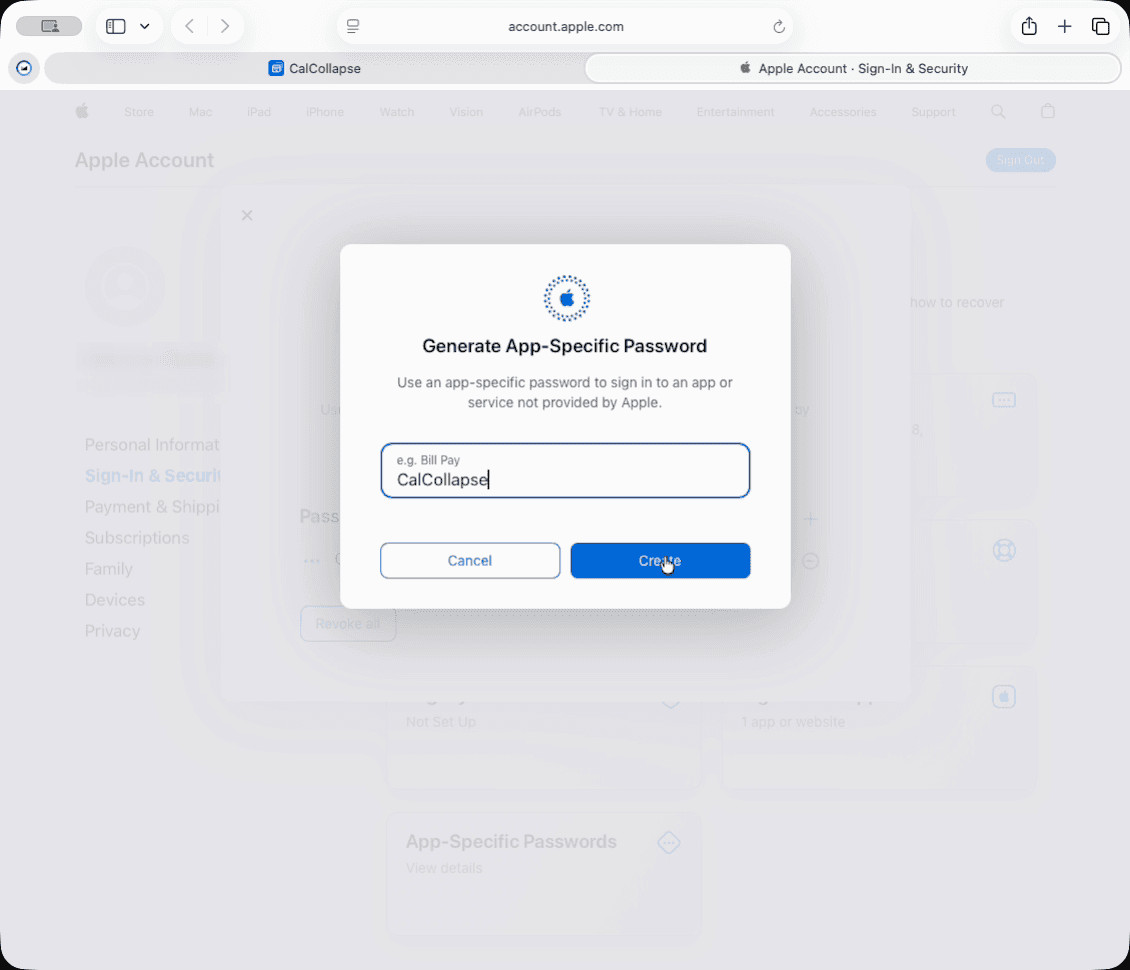
Generate one, and name it CalCollapse
The name is only a label for your own records. It is what you will look for later if you decide to revoke it.
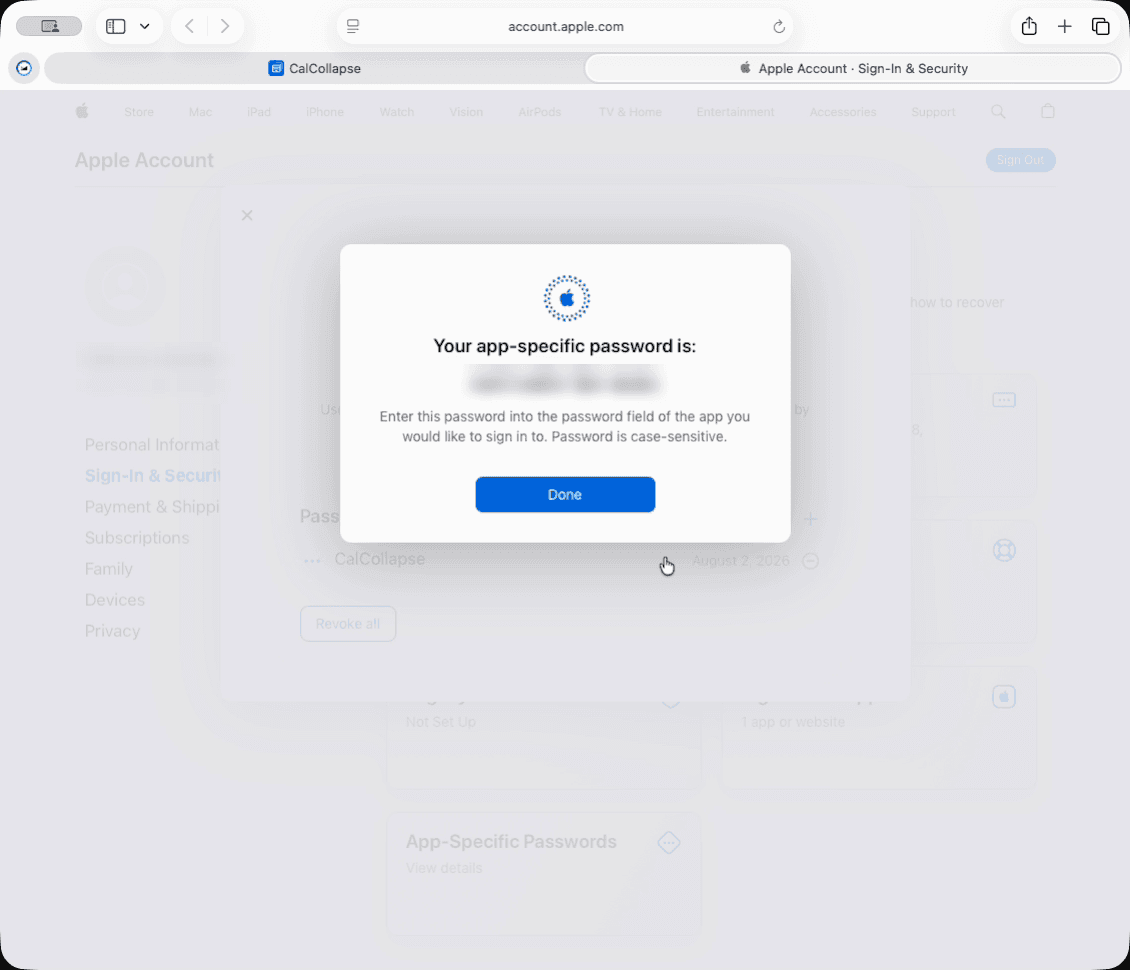
Copy the password Apple shows you
Four groups of four letters. Apple shows it once and never again, so copy it before closing the dialog.
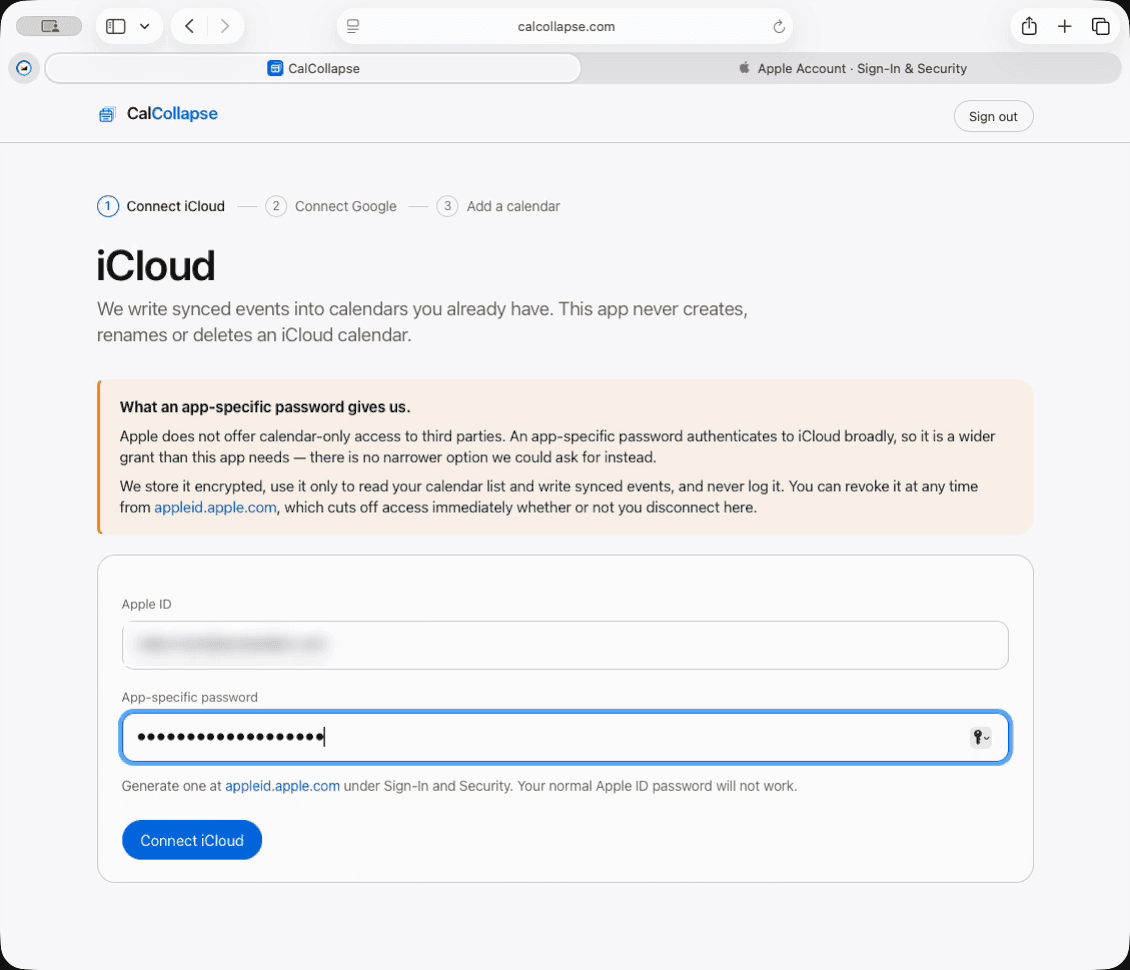
Connect iCloud
Back on CalCollapse, enter your Apple ID and paste the app-specific password. Your normal Apple ID password will not work here, which is the point of the other one.
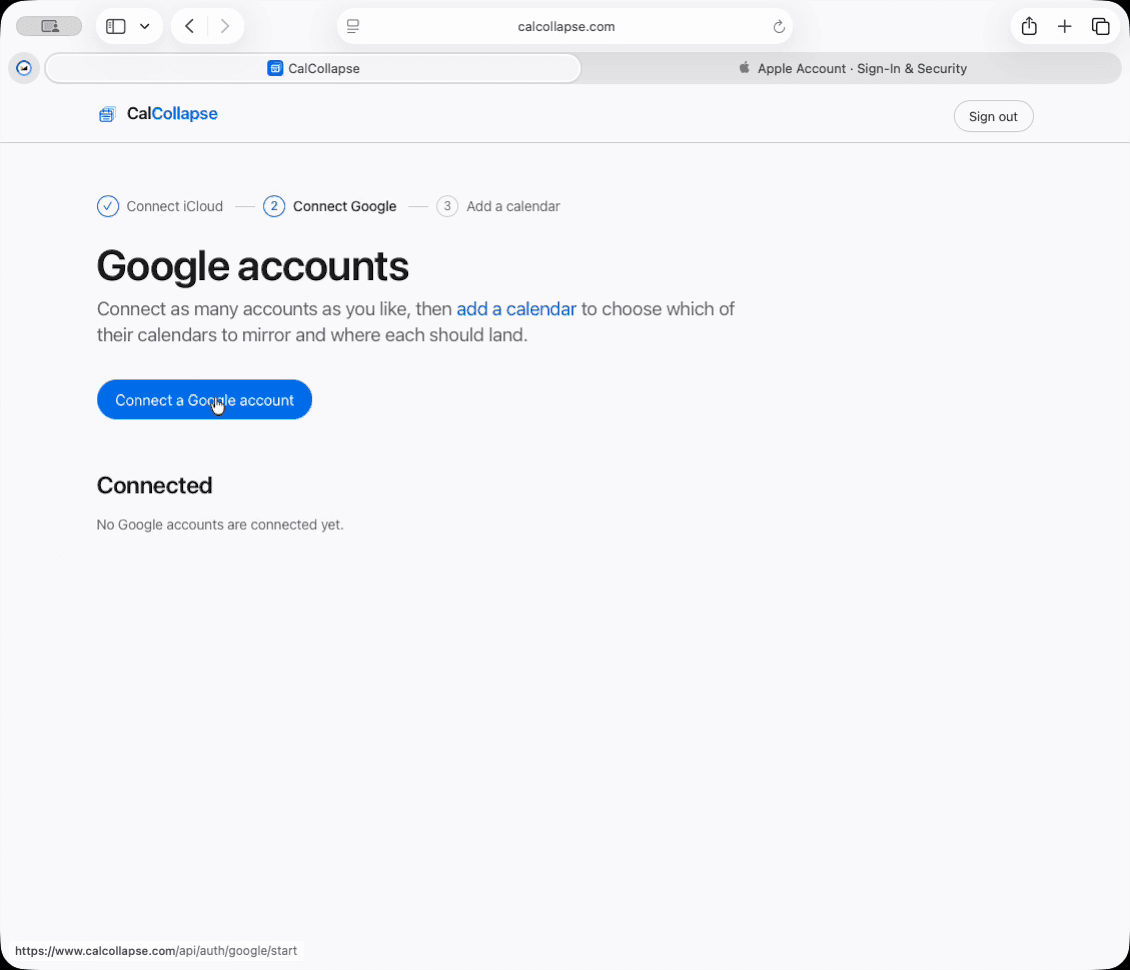
Connect a Google account
Optional. Connect as many as you like, or skip this and paste a webcal URL on the next screen instead. Each Google account is a separate authorization, and you can disconnect any of them without touching the others.
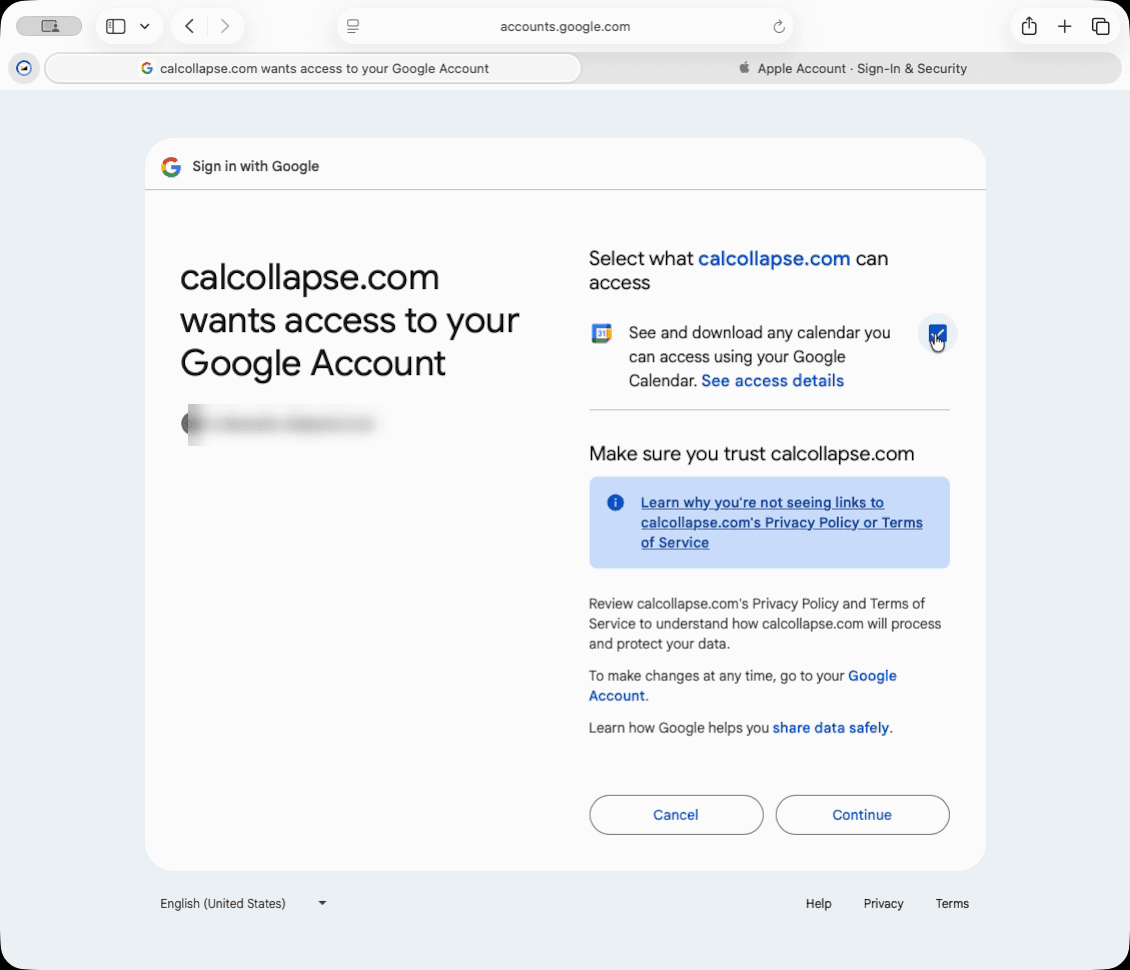
Give Google’s consent screen read access
The one permission asked for is reading your calendars. There is no box here that would let us write to Google, and we never do.
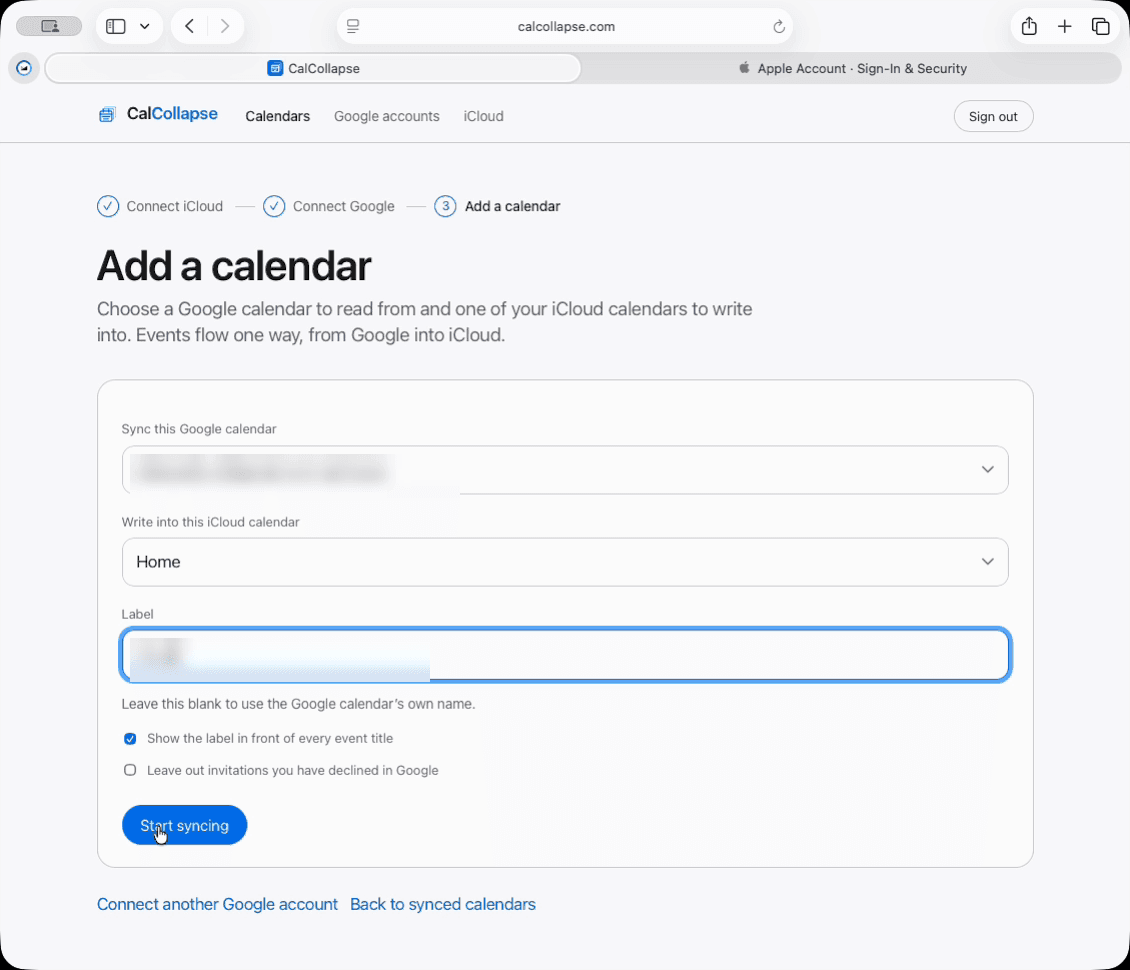
Pair a calendar with an iCloud one
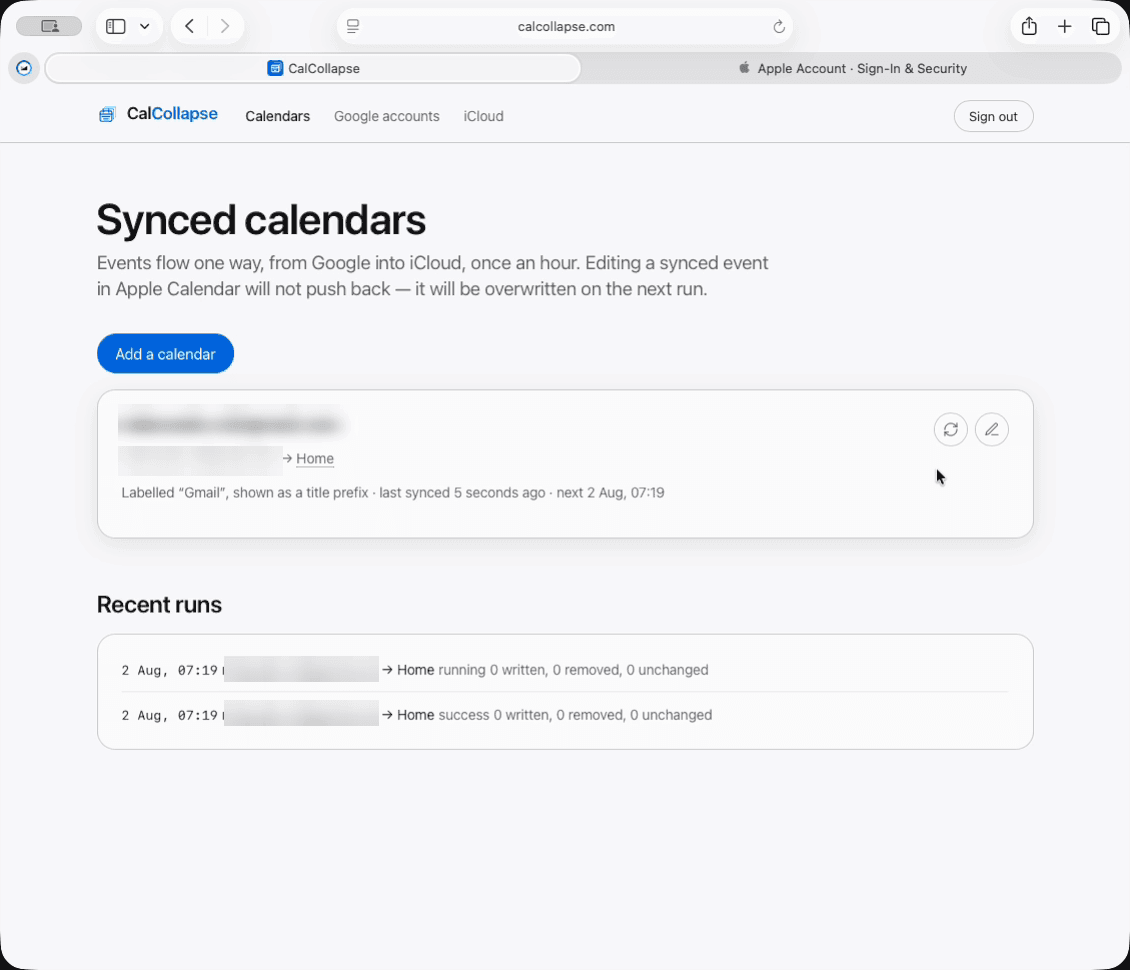
Choose a Google calendar, or paste a webcal URL from TeamSnap, ParentSquare or any other feed, and pick which of your existing iCloud calendars its events should land in. Several sources can share the same destination. Events arrive labelled with the calendar’s own name, in front of every title — [Work] Team standup — so you can tell where each one came from once they are all in one place.
That is setup
The first sync runs immediately, and after that within a minute of any change. The run log underneath tells you what each one moved.
Questions
Which way do events flow?
One way, from Google or a webcal into iCloud. Nothing is ever written back to the source. The Google access we ask for is read-only, so nothing could be written there even in principle.
Will it create or rename calendars in iCloud?
No. You pick a calendar you already have, and events are written into it. CalCollapse never creates, renames or deletes an iCloud calendar, and it only ever touches the events it wrote itself — an event you created by hand in that same calendar is invisible to it.
What if I edit a synced event in Apple Calendar?
Your edit will be overwritten on the next run. The source — Google, or the publisher of the webcal — is the source of truth for anything synced, so a change that needs to stick has to be made there.
How often does it sync?
Changes usually reach iCloud within a minute of you making them, and every 15 minutes regardless. You can also trigger a run yourself from the dashboard at any time.
Why do you need an app-specific password?
Because Apple does not offer calendar-only access to third parties. An app-specific password authenticates to iCloud broadly, so it is a wider grant than this app needs — there is no narrower option we could ask for instead. We store it encrypted, use it only to read your calendar list and write synced events, and never log it.
Can I take that access back?
At any time, and without telling us: revoke the password at appleid.apple.com and access is cut off immediately. Disconnecting iCloud here deletes our copy of the password and stops syncing, but it does not revoke the password — only you can do that.
Is Sign in with Apple the same as connecting iCloud?
No, and the two are unrelated beyond both involving Apple. Signing in identifies you and grants no calendar access whatsoever, which is why connecting iCloud is a separate step with a separate credential.
Will the people on my Google events get invitations?
No. Synced events carry no scheduling properties at all, precisely so that iCloud cannot mistake a copy of your event for an invitation and email real people. The attendee list is preserved as text in the event’s description instead, so nothing is lost from what you can read.
Can I sync a webcal instead of connecting Google?
Yes. After iCloud, paste a webcal or iCal URL — TeamSnap, ParentSquare, a secret Google iCal address, or any other feed that publishes one. Google is not required. Several feeds can land in the same iCloud calendar you already have, which is the usual reason to use this rather than adding each one as a subscribed calendar in Apple Calendar. How webcal sync works, and the same job for TeamSnap and ParentSquare.
Can I sync more than one Google account?
Yes. Connect as many as you like, and pair each of their calendars with whichever iCloud calendar suits it.
Why does Google warn that the app is not verified?
Reading your calendar is what Google calls a sensitive scope, and an app asking for one shows that interstitial until Google has verified it. Ours is not verified yet.
What will my events be called in Apple Calendar?
Each event keeps its own title with the calendar’s label in front of it, so Team standup arrives as [Work] Team standup. The label and the Google account or webcal it came from are repeated at the foot of the event’s notes. On the free plan the label is the source calendar’s own name; on the paid plan you can name it yourself, turn the prefix off and leave titles exactly as they are at the source, or replace them altogether with busy blocks.
Can I sync my work meetings without showing what they are?
Yes, on the paid plan. Each calendar pair has a switch that reduces every event it syncs to a busy block: [Work] Busy at the time the meeting occupies. The title, notes, location, video link and attendee list are never written to iCloud — not hidden there, never sent — so a phone on a table shows only that the time is taken. What is kept is when it starts, how long it runs, whether it repeats, and whether it holds the time as busy or leaves you free. Your source calendar is untouched, as always.
Can I leave out events I have declined?
Yes, on the paid plan — it is a checkbox on each calendar pair, along with the label and whether it should prefix every event title. The free plan copies declined invitations across with everything else.
How do I stop syncing, or delete everything?
Delete a calendar pair to stop that one sync, or disconnect the account to stop everything that depends on it. What we hold and how long we hold it is set out in the privacy policy.
Something is broken. Who do I ask?
Write to support@calcollapse.com and a person will answer. A calendar pair that has been failing carries a link that fills in most of the message for you.